
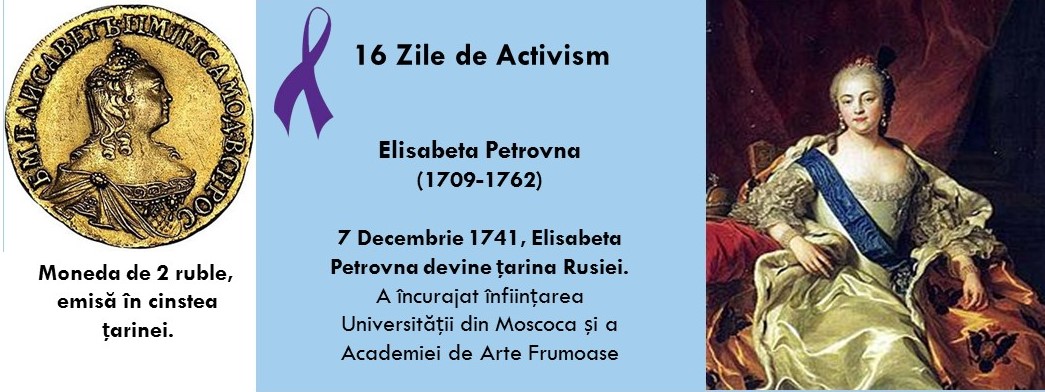
After taking the throne in 1741, Elizabeth of Russia founded her country’s first university and forged strong ties in Europe during her 20-year reign.
Elizaveta Petrovna (b. 29 December 1709 – d. 5 January 1762 ) was the Empress of Russia from 1741 until her death. She led the country into the two major European conflicts of her time: the War of Austrian Succession and the Seven Years’ War. She remains one of the most popular Russian monarchs due to her strong opposition to Prussian policies and her decision not to execute a single person during her reign.
Elizabeth grew up to be a beautiful, charming, intelligent, and vivacious young woman.
Under her reign, the Russian court was one of the most splendid in all Europe. Foreigners were amazed at the sheer luxury of the sumptuous balls and masquerades. The Russian court had steadily increased in importance throughout the 18th century and came to hold more cultural significance than many of its Western counterparts due to its inclusive nature: any “well to do inhabitants” were welcome at Court. The Court, like most Imperial Courts, was considered a reflection of the ruler at its center and Elizabeth was said to be “the laziest, most extravagant and most amorous of sovereigns.”
As historian Mikhail Shcherbatov stated, her court was “arrayed in cloth of gold, her nobles satisfied with only the most luxurious garments, the most expensive foods, the rarest drinks, and that the largest number of servants and they themselves applied this standard of lavishness to their dress as well.” [35] Clothing soon became the chosen means to display wealth and social standing at the Court. Elizabeth is reported to have owned 15,000 dresses, several thousand pairs of shoes, and a seemingly unlimited number of stockings.[13] She was known to never wear a dress twice and to change outfits from two to six times a day.
Elizabeth was renowned throughout and beyond Russia for the balls she held and her fierce commitment to the arts, particularly music, theater, and architecture. It is reported that the Empress threw two balls a week.
She was famous for spending lavishly on extravagant court ceremonies and gowns, but she proved to have keen political instincts. She abolished the Supreme Council and reconstituted the Senate, replacing many of the foreigners who held top government positions with Russians. This not only solidified the morale of the citizens, it reduced foreign influence and gave her advisors she could trust to run the country.
At the age of thirty-three, this naturally indolent and self-indulgent woman, with little knowledge and no experience of affairs, found herself at the head of a great empire at one of the most critical periods of its existence.
In 1743, with her guidance and approval, her advisors attained a historic victory in diplomacy by negotiating the end to the long-standing land dispute between Russia and Sweden. Russia’s prestige as a major European power grew in subsequent years, as Elizabeth oversaw improved relations with Great Britain and ordered a successful offensive against the powerful Prussian King Frederick II during the Seven Years’ War.
In addition to the political successes, Elizabeth contributed to major social and cultural advancements. Due to her strong religious conviction, she outlawed the death penalty in Russia.
She also encouraged the development of education and art, founding Russia’s first university (in Moscow) and the Academy of Arts (in St. Petersburg) and building the extravagant Winter Palace in St. Petersburg.
no replies