
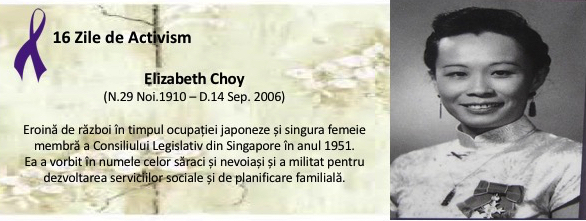
A woman ahead of her time
Elizabeth Choy Su-Mei a.k.a. Elizabeth Yong a.k.a. Yong Su Mei (born on 29 November 1910, in Kudat, Sabah – died on 14 September 2006, Singapore), a Hakka from North Borneo, noted for being a war-time heroine during the Japanese occupation and the only woman member in the Legislative Council in 1951. She was a Singaporean educator and councillor. Along with her husband, Choy Khun Heng, she supplied medicine, money and messages to prisoners of war interned in Changi Prison when the Japanese occupied Singapore during World War II.
She also posed as an artist’s model for the renowned sculptress, Dora Gordine, who has done two works of her, entitled Serene Jade and Flawless Crystal. She worked as a teacher and became the first principal of the Singapore School for the Blind. She was also known for her qipaos and bangles, for which she was nicknamed “the Dayak woman of Singapore”.
Elizabeth was born in Kudat, in British North Borneo (today Sabah). Her great-grandparents assisted German missionaries in Hong Kong and their work brought them to North Borneo. There, the Yong family set up a coconut plantation. Her father was the eldest in a family of 11 children and after completing his early education in China with some English education in North Borneo, he gained employment as a civil servant. Marrying the daughter of a priest from a well-respected family in North Borneo, he was transferred to Jesselton and later promoted to District Officer and moved on to Borneo’s interiors in Kalimantan. Elizabeth was looked after by a Kadazan nanny and acquired Kadazan as her first language.
Later, Elizabeth’s father was posted to Tenom where no educational facilities existed, so Elizabeth and her siblings were sent back to Kudat where her paternal grandfather ran the village school, teaching in Chinese. Between 1921 and 1929, she went to an Anglican missionary boarding school in Sandakan. Because the teachers could not pronounce Chinese names, she adopted the English name Elizabeth.
In 1925, she and her aunt Jessie became the first girls to sign up in North Borneo’s inaugural Girl Guides Company. By 1927, she taught the lower standards while she was studying.
In December 1929, she came to Singapore to further her studies at the Convent of the Holy Infant Jesus on Victoria Street. She shone academically, obtaining the Prize of Honor in her first year of school in December 1930. She resided with her fourth uncle at Selegie where he ran a music shop, the original T. M. A. on High Street. The untimely death of her mother in 1931 and the onset of the Great Depression placed upon her the burden of raising her six younger siblings. Thus she had to give up on college education, and even on a possible scholarship, in order to start work so she could finance the education of her younger siblings.
During the Japanese Occupation, she worked as a canteen operator with her husband at the Mental Hospital which was renamed Miyako Hospital (the predecessor of Woodbridge Hospital) where patients from General Hospital had been moved to. They secretly brought food, medicine, money, messages and even radios to British internees. Unfortunately, they were caught by the Japanese and Elizabeth was arrested on November 15, 1943, following her husband’s arrest on October 29, a few weeks earlier. Believing their activities were related to the Double Tenth incident, she spent almost 200 days at the hands of the Japanese occupiers but never once did she show signs of conceding. The torture she went through at the hands of the Kempeitiai made even the hardest of men break down, but her spirit was indomitable, 200 days of starvation and repeated torture.
“When my interrogators could not get any information out of me, they dragged my husband from Outram Prison, tied him up and made him kneel beside me. Then, in his full view, they stripped me to the waist and applied electric currents to me. I cannot describe the pain, but it must have been thousands of times worse for my husband who had to see me being tortured.”
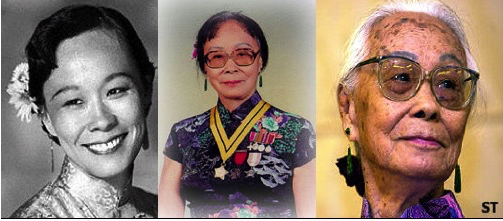
After the war, Elizabeth was invited to England as a celebrated war heroine noted as the only female local to have been incarcerated for such an extended period. She went there as part of the privileged few who were invited to Britain to recuperate from the war but her stay extended three more years, totaling four years there. In her first year, she was invited to meet Queen Elizabeth. In her second year, she took up Domestic Science at Northern Polytechnic and in her third year, she taught at a London Council School. Intent on studying art but without the finances for this venture, Elizabeth resorted to posing for art instead. The famed sculptress, Dora Gordine, made two sculptures of her – “Serene Jade” and “Flawless Crystal”. Elizabeth gave her copy of “Serene Jade” to her daughters who, in turn, donated it to the Singapore Art Museum. Her copy of “Flawless Crystal” sits in an art gallery in Leicester, Britain.
She returned to Singapore in December 1949 and was persuaded to stand for elections in December 1950 for the West Ward or Cairnhill constituency under the banner of the Labor Party, founded in 1948 by V. J. Mendis. She was nominated into the Legislative Council in 1951, becoming the only woman member there. She served for a full five-year term. As a member of the Legislative Council, she represented Singapore at the Coronation of Queen Elizabeth II in June 1953. She later stood for elections in Queenstown but bowed out from politics thereafter, believing she could do more for the country as a teacher.
In the 1950s, she joined the women’s auxiliary of the Singapore Volunteers Corps, and was instrumental in expanding the organisation when she recruited many of her friends and colleagues.
Choy’s teaching career at St Andrew’s School continued until 1974, except for a four-year spell as the first principal, as well as a teacher, at the Singapore School for the Blind from 1956. After her retirement she improved her languages and traveled. She continued with social work and school visits into her 90s, impressing young Singaporeans with the need to maintain strong national defense.
Choy was also noted for wearing traditional Chinese and Indian clothing, qipaos and bangles, which earned her the nickname “Dayak Woman of Singapore”.
Choy died from pancreatic cancer in 2006 at the age of 96.
She received numerous awards, among them: the Order of the British Empire in 1950, Order of the Star of Sarawak, The Girls Guide Bronze Cross and Pingkat Bakti Setia, Singapore, for her service of at least four decades in education in 1973.
no replies