
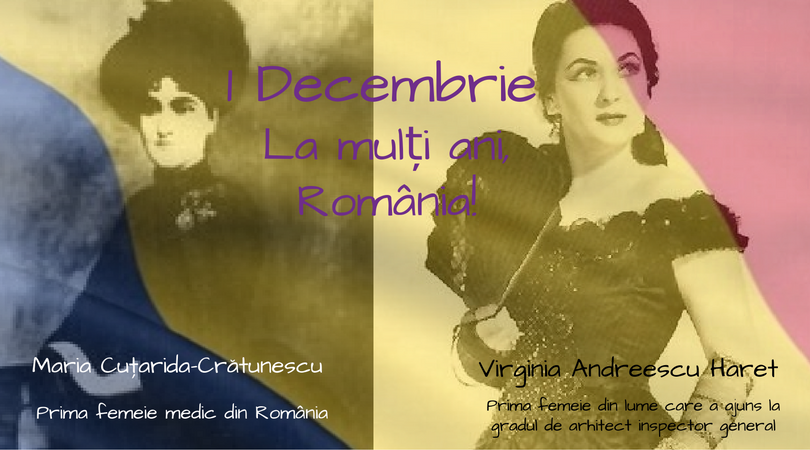
Wishing to promote Romanian women who have made history in Romania and abroad, we present you two Romanian women of the nineteenth century that out of desire to study and for social propensity managed to overcome gender barriers that characterised those times and to establish themselves as the first MD woman from Eastern Europe and, respectively, the first woman in the world who reached the rank of inspector general architect.
Maria Cuţarida-Crătunescu – first woman doctor in Romania
Maria Cuţarida-Crătunescu was born on February 10, 1857 in Calarași and did high school studies at Central School in Bucharest and Zurich. In 1877, when șhe was just 20 years old she enrolled at the Faculty of Medicine in Zurich, but soon transferred to the University of Montpellier, where she did her undergraduate thesis. She choose Paris for an internship perhaps because there was a better chance to continue with doctoral studies. In 1884 she became the first woman from Eastern Europe with a doctorate in Medicine, and her thesis dealt with a theme that would demonstrate her perpetuate interest in women’s health : “L’hydrorrhée to valeur et dans le cancer sémiologique del’uterus du corps “(About hidroree and its semiological value in uterine cancer).
Even the Romanian press has followed and marked her throughout with laudatory articles. While studying abroad, newspapers titled: “A Romanian talks about her successes studying abroad” (Press) or “A Romanian woman, MD” (Românul).
One might say that all this praise and happy comments will help her enter without any hindrance for a position hitherto reserved for men. But it was not so from the beginning. In the fall of 1884 she returned to the country to get the right to free practice and equate her foreign diploma that she passed magna cum laude. She requested to Brâncovenesc Hospital for a post of secondary physician at the station “Diseases of Women”.
It looks like a maximum grade was not enough for a woman to practice medicine in Romania at the time, since she was rejected without explanation by the Hospital, giving her a post of professor of hygiene.
She did not become discouraged and opened a private practice and in 1885, she ran for a post of secondary physician at Philanthropy Hospital in Bucharest, where she gave free consultations.
Although it has been well prepared for the competition to obtain the degree of MD gynecologist, rejecting it strikes again. He did not give any moment back in 1886 and became head of the department of hygiene of the Asylum “Lady Elena” and in 1891 and gynecology department of Philanthropy. But in 1894, Eforia Hospitals decided to change the profile of the gynecology department where work in gynecological surgery, thus changing and competition schedule. Maria Cuţarida-Crătunescu protest, but to no avail, and the conflict between her and Eforie was deepened, leading to resignation.
t that point he decided to concentrate their efforts in one direction Social deeper by establishing in 1897 Societatea Maternă, in order to protect poor children and two years later organized the first nursery at Tobacco Factory in Bucharest, where he assured consultations for 2000 workers, between 1885-1898.
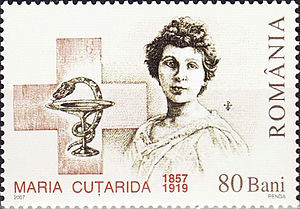 And so, she begins a remarkable activity on the feminist front. She has presented at The Congress of feminist actions, held in Paris in 1900, the paper Le Travail de la femme en Roumanie (Work women in Romania), forming a statistic of women who have succeeded in promoting intellectually “the number resulting from academic titles granted to 825 girls over 26 years speaks enough for our intellectual activity. Indeed, since 1875, from promoting first girls in high school in Romania, their number amounted to 432 baccalaureate, 40 licensed in Letters and 21 degree in 12 doctors in Health, a doctor in Law from the University of Paris and a undergraduate of Law, 319 teachers of secondary school and two girls licensed in Pharmacy. If this number is added to that of our artists and women of letters untitled, it will be quite eloquent to show how great is the enthusiasm Romanian women have for intellectual work .”
She was invited to the congress in Brussels (1907) and Copenhagen (1910), where he presented the actions initiated by the Romanian medicine against infant mortality and a survey of nurseries in Romania. Was mobilized during World War at the Institute and Evangelical boarding house sharing Queen Mary’s vocation of compassion. At the end of the war, on health grounds, Maria Cuţarida-Crătunescu is urged to withdraw from medical and social work.
Shortly at only 62, she passed away being surrounded by some of her disciples, who learned from her tenacity and feminist vocation.
Maria Virginia Andreescu Haret – first woman in the world who reached the rank of inspector general architect
Maria Virginia Andreescu Haret was born on June 21, 1894 and was the niece of the great painter Ion Andreescu (real name being Dobrescu). Left motherless at only 9 years old, the student had to dedicate and care of three younger brothers. With inclination toward discipline she did high school in particular, and in 1912, after obtaining the baccalaureate at Mihai Viteazul High School , she came first in the entrance examination of the School of Architecture in Bucharest. Grades obtained show a brilliant student, noticed by Petre Antonescu, the teacher who included her in his team and under whose coordination has worked on numerous construction sites buildings designed by him.
On July 6, 1919 her diploma project on “An Academy of Arts” has obtained the highest mark, “admitted the words very well.” It was “the first architect diploma attributed to women” in Romania, worldwide being the fourth in chronological order! The project was presented at the Graduate School of Architecture exhibition held at the Romanian Athenaeum in 1925 and was awarded by the Ministry of Education.
Note that, in parallel with the School of Architecture, she was taking the courses of painter Hipolit Strâmbu, teacher at the Academy of Fine Arts. A year later, at the insistence of Strâmbu teacher, she organised an exhibition comprising 66 sketches, drawings and watercolours. 28 of them were purchased by the Historical Monuments Commission and exhibited in the halls of this institution on Street Berthelot, other 8 being purchased by the Academy, appearing alongside the Cabinet of Stamps catalog collections. The success of the exhibition has not surprised anyone. Rating granted by the Board of Architect has propelled it to the Commission of Historical Monuments cartoonist surveys.
In the spring of 1922 she participated in a study trip for architects and student-architects in the Kingdom of Serbs, Croats and Slovenes, which he commented in a “report with sketches and drawings” published in the journal “Fine Arts” then, with money obtained from the sale of the works in the exhibition has funded a study trip to Italy. In Rome she worked for a year and a half in the studio of Professor Gr. Bargelini, but participated as a designer and excavations together with Professor Montech and members of the Society “Fra i cultori dell arhitettura e arheologia”. As used, she followed parallel courses at the Department “interior decoration” in the College of Architecture in Rome, which she graduated brilliantly.
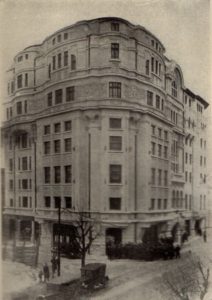 Returning to the country in the second half of 1923 started working at Technical Service of the Ministry of Education, working until 1947, when he was retired. She worked at school buildings, quickly reaching the right hand of chief architect Ion Pompilian (1872-1938), professor at the School of Architecture. After her plans were built the imposing buildings of the high school “Gheorghe Sincai” (1924-1928), wing Calea Șerban Vodă and “Cantemir Vodă” (1926-1929), the wing Str. Future 60, a number of blocks on Calea Victoriei and many other buildings in Romania. It deserves some emphasis: after execution of 40 projects she reached the first woman to achieve the degree of Architect Inspector General of Romania! There can therefore be no surprise that, over the years, she participated as a delegate of the Society of Romanian Architects and the Ministry of Education in various meetings and congresses: Congress AGIR from Cernăuți in 1925, followed by congresses in Rome, Paris and Brussels or Moscow, held in 1937, where she was invited by the Union of Architects of the USSR.
She died on May 6, 1962 and was buried in Bucharest at Bellu Orthodox Cemetery , with her husband Spiru Haret (1892-1970) and father-in-law, Acad. Univ. Minister of Education Spiru Haret (1851-1912).
no replies